
PROJECT 1
EcoSpeak: Bridging Language, Society, Technology, and Education in Environmental Discourse
Editors: Mohamed Mliless, Mohammed Larouz, Mohamed Yeou, and
Abdelmajid Bouziane (Morocco)
Several key trends are emerging at the intersection of language and environmental issues in contemporary research. These trends encompass the study of how language shapes sustainable behaviors and influences the feasibility of pro-environmental actions. A particular focus is placed on the power of language in promoting green narratives, enhancing the restoration and the preservation of water resources and ecosystems, and teaching language skills for effective environmental communication. In the scholarly domain, we extend an invitation for contributions to an imminent collaborative publication titled “Language and the Environment: Intersections of Ecolinguistics, Education, and Technology in Environmental Discourse”. This prospective volume aspires to provide an exhaustive exploration of the intricate relationships between language and the environment. The book will encompass a wide array of topics, each contributing to a profound understanding of how language reciprocally shapes and is shaped by our interactions with the environment. We cordially invite contributors to submit both theoretical expositions and casestudies that emphasize the interaction between language and environmental issues, thereby providing palpable illustrations of the concepts discussed in the book.

PROJECT 1
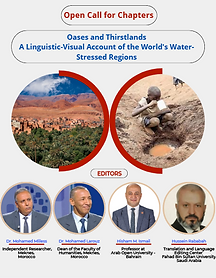
Oases and Thirstlands A Linguistic-Visual Account of the World's Water-Stressed Regions
Editors: Mohamed Mliless, Mohammed Larouz (Morocco), Hisham M. Ismail (Bahrain), Hussein Rababeh (Saudia Arabia)
The book project seeks to bridge traditional knowledge systems with contemporary challenges, examining both successful adaptations and ongoing struggles in water-stressed environments worldwide. We invite contributions that utilize diverse modes of expression, including but not limited to literary analysis, ethnographic accounts, visual essays, and interdisciplinary studies, to shed light on the multifaceted nature of water narratives in water-scarce regions. The goal is to create a comprehensive resource that illuminates the human experience of navigating life with limited water access, while also highlighting innovative strategies for water stewardship and community resilience.
Copy
PROJECT 3
Frontiers of Environmental Law Enforcement Innovations, Challenges, and Global Responses
Editors: Mohamed Mliless (Morocco), Mamdooh Abdelmottlep (USA), Hector R. Garcia (USA)
This project aims to bring together varied perspectives and cutting-edge chapters on the complex interplay of law, science, technology, and society in the field of environmental protection. Environmental crimes have evolved significantly in response to global developments, necessitating a multifaceted approach to combat them effectively. As climate change, technological advancements, and socioeconomic transformations reshape our world, so too do they influence the nature and scope of environmental offenses. In light of these changes, novel legal frameworks and enforcement techniques have emerged to address pressing concerns such as international environmental crimes, ecocide, and offenses committed in digital spaces. These innovative approaches are further bolstered by the integration of sophisticated technologies, with artificial intelligence, blockchain, and remote sensing playing pivotal roles in detecting, preventing, and prosecuting environmental violations. Complementing these technological advancements is the growing involvement of non-state actors in environmental protection efforts. NGOs, indigenous groups, and citizen scientists are increasingly contributing their unique perspectives and resources to environmental law enforcement and crime prevention, creating a more comprehensive and inclusive approach to safeguarding our planet.
